DuskVerb
Professional Algorithmic Reverb
Pre-release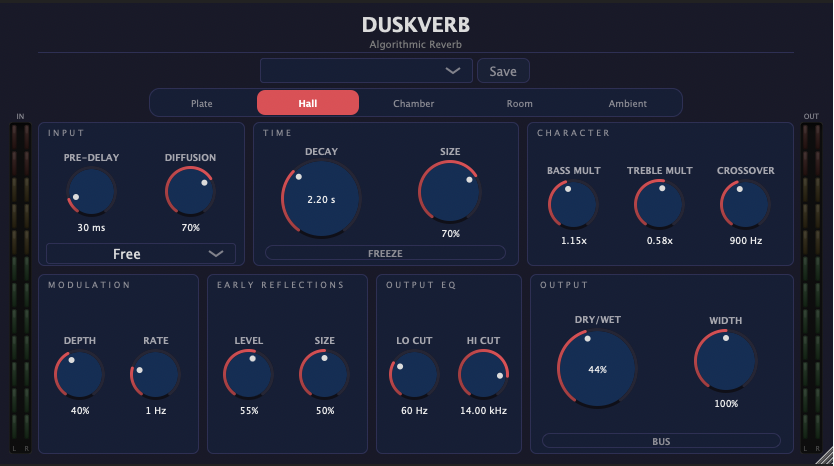
DuskVerb is a free algorithmic reverb that covers everything from tight rooms to infinite ambient washes. Five algorithms, 25 presets, and enough control to dial in exactly the space you need.
Overview
At its core, DuskVerb uses a 16-channel Hadamard feedback delay network to build dense, natural-sounding reverb tails. Each algorithm has its own carefully tuned delay structure, and the Dattorro-inspired diffusion stages smooth everything into a lush, coherent wash. The early reflections are physically modeled with air absorption, so small spaces actually sound like small spaces.
Algorithms
Each algorithm has its own delay line configuration and default character. They’re not just preset tweaks - the underlying topology changes.
Plate is dense, smooth, and bright. No early reflections, just pure diffuse tail. The classic studio vocal reverb. Works great on snare and mix bus too.
Hall is the all-purpose workhorse. Natural concert hall sound with spacious depth, strong early reflections, and balanced frequency response. If you only use one algorithm, this is probably it.
Chamber sits between Hall and Room. Warm and intimate, with a slightly brighter treble response that helps things cut through. Good for strings, piano, and acoustic instruments.
Room is tight and realistic. The early reflections are prominent, giving you a clear sense of physical space, while the late decay stays short and clean. Great for drums, dialog, and anything that needs natural ambience without a long tail.
Ambient goes big. Ethereal washes, long decay times, heavy modulation, and no early reflections. This is your pad reverb, your drone reverb, your cinematic effects reverb.
Controls
The top row handles the big picture: Decay sets the tail length (0.2s up to 30s), Pre-Delay adds a gap before the reverb starts (with optional tempo sync), and Size scales the virtual room dimensions. Hit Freeze to sustain the current tail indefinitely while muting new input.
The Character section shapes the tone. Diffusion controls how dense the tail is. Bass Multiply and Treble Multiply let you independently adjust how long the lows and highs sustain relative to the overall decay time. Crossover sets the frequency split between the two bands.
Modulation adds movement to the tail. A little goes a long way for keeping things sounding natural and avoiding metallic artifacts. Crank it for chorus-like shimmer effects.
The Output section has your Mix knob, Width control (0-200%), and Lo Cut / Hi Cut filters for shaping the reverb’s frequency range. Bus Mode sets the mix to 100% wet for send/return setups.
Factory Presets
DuskVerb ships with 25 presets across 9 categories. You can also save, load, and delete your own presets from the menu.
- Vocals: Vocal Plate, Vocal Hall, Vocal Room
- Drums: Drum Room, Drum Plate, Drum Ambient
- Guitar: Guitar Spring, Guitar Hall
- Keys: Keys Chamber, Synth Pad
- Mix: Mix Glue, Mix Space
- Rooms: Small Room, Medium Room, Large Hall
- Plates: Short Plate, Long Plate
- Ambient: Infinite Pad, Dark Cloud, Shimmer Space, Cathedral
- Special: Slap Back, Gated Verb, Lo-Fi Verb, Wide Stereo
Under the Hood
For the curious: the FDN uses a 16x16 Hadamard mixing matrix with per-channel two-band damping filters. Input diffusion is a 4-stage Dattorro allpass cascade, and there’s an additional 2-stage modulated output diffuser. Early reflections use 16 multi-tap delays per channel with exponential time distribution and air absorption modeling. Delay reads use cubic Hermite interpolation, and all parameters are smoothed per-sample to avoid automation artifacts.
DAW Compatibility
Tested in Logic Pro (AU), Reaper (VST3/LV2), and Ardour (LV2). Should also work in Bitwig, Studio One, FL Studio, Ableton Live, Cubase, and GarageBand.
Installation
Linux
VST3: ~/.vst3/DuskVerb.vst3
LV2:  ~/.lv2/DuskVerb.lv2
Windows
VST3: C:\Program Files\Common Files\VST3\DuskVerb.vst3
macOS
VST3: ~/Library/Audio/Plug-Ins/VST3/DuskVerb.vst3
AU:   ~/Library/Audio/Plug-Ins/Components/DuskVerb.component
Open Source
DuskVerb is open source under GPL-2.0. View the source, report issues, or contribute on GitHub.
Features
- Five algorithms - Plate, Hall, Chamber, Room, Ambient
- Dense, natural tails from a 16-channel feedback delay network
- Dattorro-inspired input diffusion for smooth buildup
- Physically-modeled early reflections with air absorption
- Pre-delay with tempo sync
- Two-band damping with adjustable crossover
- Independent bass and treble decay control
- LFO modulation for movement in the tail
- Freeze mode for infinite sustain
- Output EQ, stereo width, and bus mode
- 25 factory presets across 9 categories
- User preset save/load/delete
- Full automation support
Changelog
v0.3.0 2026-02-26
- Replaced FDN output soft-clipping with linear output for better transient dynamics
- Redesigned Room algorithm with geometric delay spacing and increased modulation
- Moved DC blocker before output diffusion to prevent allpass DC accumulation
- Fixed algorithm selector picking the wrong algorithm
- Fixed dropdown overlapping knob labels
- Consistent decimal formatting across all displays
v0.2.0 2026-02-25
- Initial release with VST3/LV2/AU support
- Five algorithms (Plate, Hall, Chamber, Room, Ambient)
- 16-channel Hadamard FDN with two-band damping
- Dattorro-style input diffusion and output diffusion
- Early reflections with air absorption modeling
- Pre-delay with tempo sync
- Freeze mode, bus mode, stereo width control
- 25 factory presets across 9 categories
- User preset system with save/load/delete
- Available for Linux, Windows, and macOS